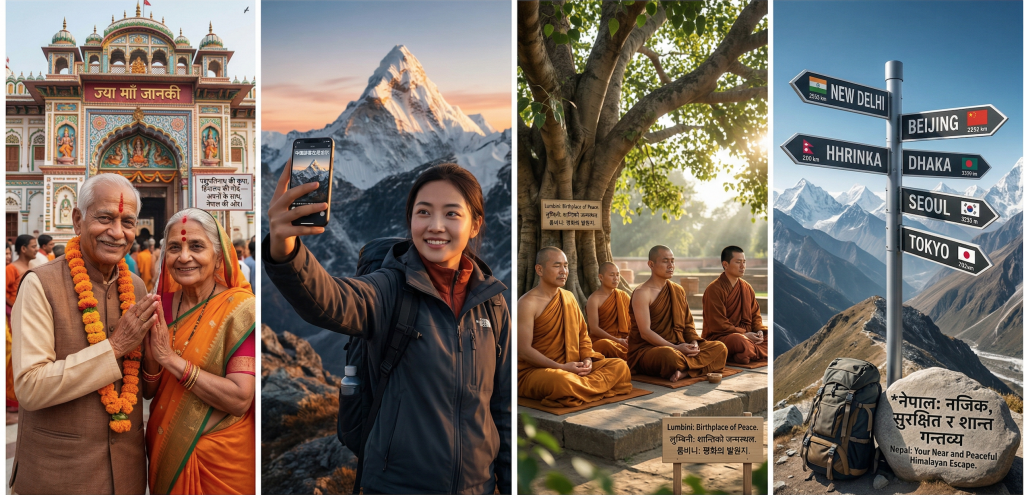
Ongoing conflicts in the Middle East have prompted widespread airspace closures and flight cancellations, disrupting Asia–Europe and Asia–America routes. Major Gulf hubs (Dubai, Doha, Abu Dhabi, Kuwait, etc.) are partially or fully closed, forcing airlines to reroute via northern corridors (Caucasus/Afghanistan) or southern paths (Egypt–Saudi–Oman). This has added 2–4 hours to flight times and driven up fares, but Nepal remains largely reachable via alternative routings and regional carriers.
In fact, Nepal’s busy peak season (Spring/Autumn) is a compelling time to visit – tourism is almost fully recovered, accounting for 7–8% of GDP, and outstanding Himalayan adventures await. Despite headlines, Nepal is stable and safe compared to many neighbors. The country welcomes visitors with simple visa rules (Indians visa-free, Chinese and other nationals visa-on-arrival), competitive prices, and world-class trekking. Leading local outfit Great Nepal Treks & Expeditions (GNTE), a highly-rated NTB/TAAN/NMA‑affiliated agency, offers expert guides, curated itineraries, and strict safety protocols for Australian, Indian, Chinese, and other travellers. This blog analyzes the current air travel disruptions and their impact on Nepal, assesses safety and investment indicators, and shows why NOW is the time to book that Himalayan adventure with GNTE.
Global Airspace Disruptions: Middle East Conflict Update
Recent escalation in the Iran–Israel–U.S. conflict (early 2026) has led to major airspace closures and flight diversions. Iran, Iraq, Kuwait and Syria have closed their airspace; Israel, Bahrain, UAE and Qatar are on high alert with sudden short‑notice closures. As Australian Smartraveller warns, “widespread airspace closures” and flight cancellations are affecting travel globally. Tens of thousands of flights have been affected: routes that normally thread the Gulf corridor are now off-limits, forcing carriers to detour. For example, Asia–Europe flights now typically reroute north via the Caucasus and Afghanistan or south via Egypt–Saudi Arabia–Oman. (See diagram below.) Although these corridors remain open, they add time and fuel cost (2–4 extra hours). Airlines have responded by canceling non-essential Gulf routes and adding alternatives: Emirates and Qatar Airways are cutting back flights to Dubai/Doha, while Gulf carriers like FlyDubai and Etihad operate skeleton schedules. For instance, Singapore Airlines suspended its Dubai route through April and boosted London/Sydney flights. The net effect: Middle Eastern hubs are impaired as transit points, but Asia–Asia and Asia–India travel largely continues via alternate routes and regional carriers.
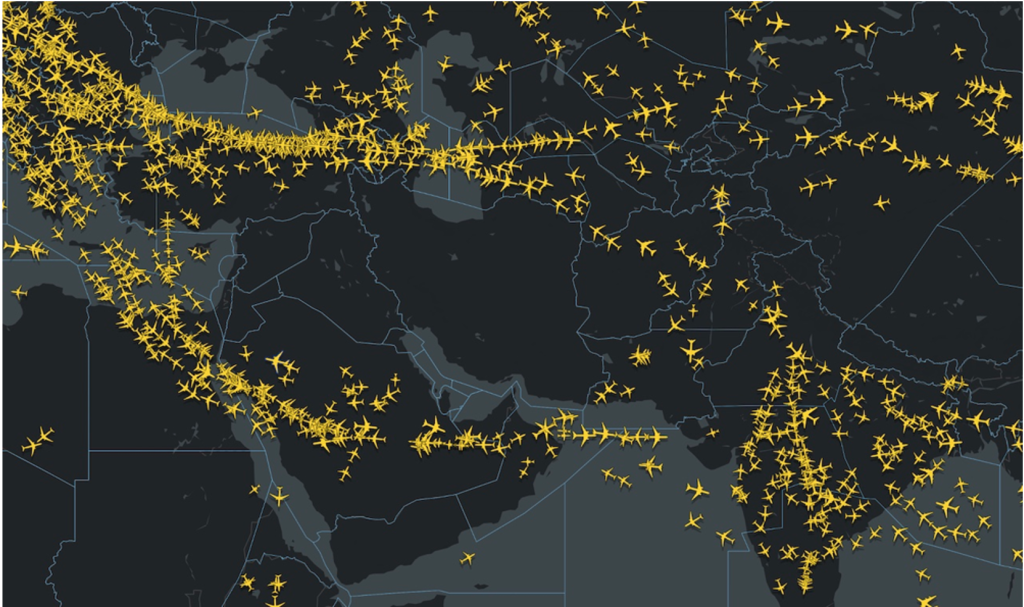
Figure: Flight traffic on March 3, 2026 (yellow plane icons) shows many flights using northern and southern bypasses to avoid closed Middle East airspace.
These disruptions also ripple through ticket prices. Industry analysts report prices up 20–25% on some Asia–Europe routes, with fuel surcharges rising. Australia’s Qantas is even expanding Europe services (e.g. Sydney–Rome, Perth–London) to meet demand for direct alternatives.
Impact on Nepal: Connectivity and Tourism Disruption
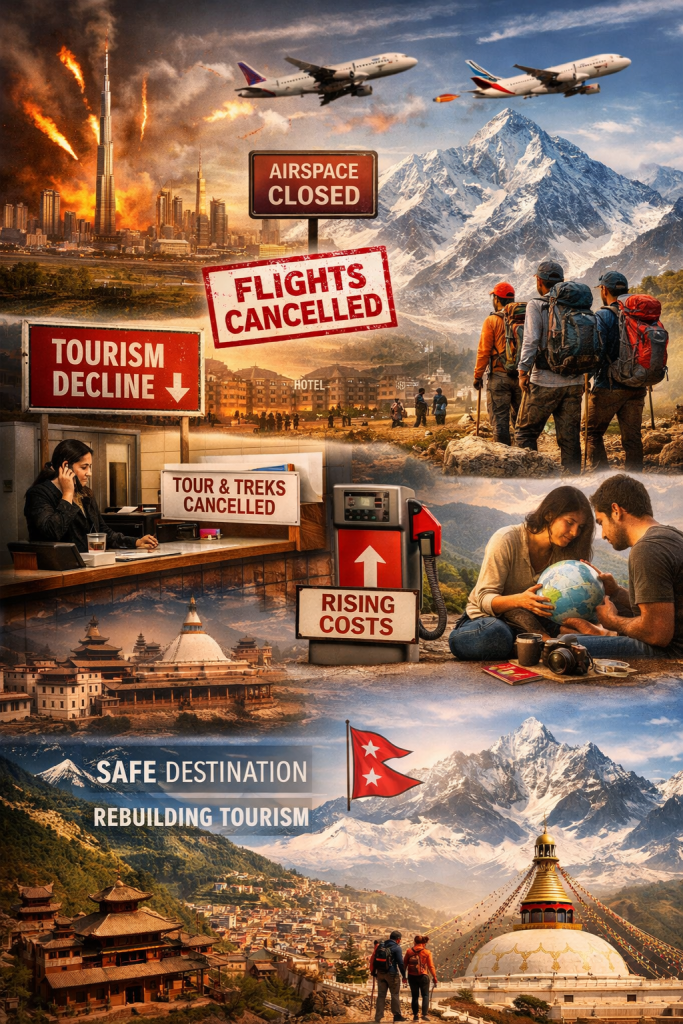
Nepal’s international connectivity relies heavily on Gulf transit, so the crisis has delivered a blow. Over the last week of March 2026, Nepal’s Civil Aviation Authority reported 75 flights to/from Middle Eastern hubs were canceled. Tribhuvan International Airport (Kathmandu) and new regional airports have seen cancellations from Nepal Airlines, IndiGo, Qatar Airways and others. According to Kathmandu Post, this has hit the spring tourism season hard: many tour groups and hotel bookings (peaking Mar–May) have been scrapped. Occupancy in Kathmandu and Pokhara dropped from near 90% to around 50%, and tour operators report 50–70% cancellation rates for April bookings. Notably, all flights to Dubai/Doha have been halted by Nepal Airlines (as of late March).
However, some counter-trends offer hope. Travelers en route to Nepal from Asia are rerouting via Southeast Asia and India. The Post notes instances of tour groups flying via Bangkok or New Delhi instead of Dubai. For example, budget travelers can fly Singapore–KTM on Scoot or SilkAir, bypassing the Middle East entirely. India’s open border and multiple daily flights (Air India, Nepal Airlines, IndiGo) provide a stable corridor. Chinese tourists can use direct flights (Air China Beijing–KTM) or Hong Kong/Kunming connections. Indeed, Reuters highlights that Asian carriers (Turkish, Malaysian, Asian airlines) are expanding services or adding flights to Asia to absorb some of the diverted traffic.
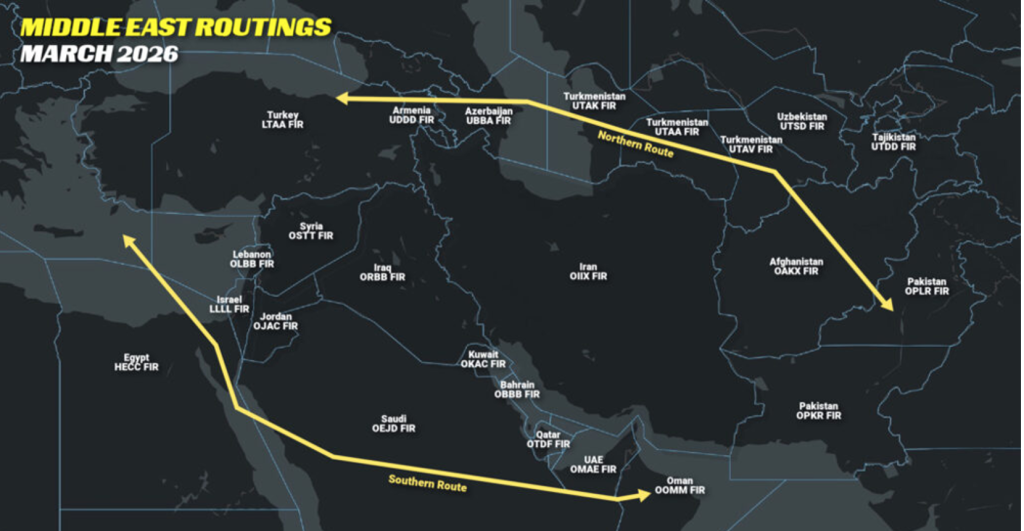
Figure: Alternate flight routes avoiding the Gulf. Because Iran/Iraq/Kuwait are closed, Europe–Asia flights detour north via the Caucasus/Afghanistan (blue arrows) or south via Egypt–Saudi–Oman (orange).
Effect on tourism bookings: The Middle East war coincides with Nepal’s peak season. NTB figures show Nepal saw 128k arrivals in October and 98k in December 2025 – spring (Apr–May) is comparably busy. The sudden disruptions in March 2026 likely push some intended visitors to postpone or re-route. Kathmandu Post quotes industry leaders warning of a “crisis” in April bookings. Nonetheless, the NTB expects full-year arrivals to still exceed 1.15 million (2026 projections), as markets diversify. Indeed, Australia’s Qantas and Singapore Airlines are adding Asia routes, improving access to Nepal.
Safety & Investment Climate
Traveler safety (crime/political stability): Official travel advisories rank Nepal as “exercise a high degree of caution” (Smartraveller, Mar 2026). This largely reflects occasional strikes, protests and natural hazards, not terrorism. In fact, Nepal has become more peaceful: it rose to 76th in the 2025 Global Peace Index, second only to Bhutan in South Asia. Homicide and violent crime rates are low; by comparison, neighboring South Asian countries rank much lower. Petty crime (bag-snatching, pickpocketing) does occur in Kathmandu and tourist areas, so standard precautions apply (keep valuables secure, don’t trek alone at night). The Himalayan Rescue Association (HRA) operates first-aid posts on popular treks, and GNTE guides carry medical kits. Smartraveller also notes environmental/health risks: altitude sickness above 2,500 m (very relevant for Everest/Langtang treks), seasonal air pollution in Kathmandu, and mosquito-borne diseases in Terai/Chitwan. Travellers should get relevant vaccinations and insurance, but otherwise enjoy that Nepal ranks as one of the region’s safer destinations.
Infrastructure: Nepal’s tourism infrastructure is improving. Tribhuvan International Airport (Kathmandu) is older but busy; new international airports at Pokhara and Lumbini (underway) will expand capacity. Roads are gradually being upgraded (the 2025 budget saw heavy FDI in highways). Mobile connectivity and ATMs are common in cities and major trek towns. Compared to global standards, travellers should expect basic facilities in rural areas (camping or teahouses).
Tourism investment climate: Nepal actively seeks tourism investment. Tourism contributes7–8% of GDP and employs over a million people. The World Bank noted tourism is a key service sector (pre-crisis). In 2025 alone, tourism accounted for 103 new FDI projects (hotels, eco-lodges, trekking services). Legal barriers are low: 100% foreign ownership is permitted, taxes are relatively low, and double-tax treaties exist with most partners. Nepal also offers favorable tourist visas: Indians enter visa-free (open border); Chinese get free 30-day visa-on-arrival; Australians and other nationalities can obtain 15/30/90-day tourist visas on arrival at KTM for a modest fee (e.g. US$50 for 30 days). All this underscores Nepal’s friendly environment for both tourist arrivals and long-term investment.
Top Attractions and Seasons
Nepal’s appeal is unique. From towering peaks to cultural heritage sites, highlights include:
- Himalayan Treks: Everest Base Camp, Annapurna Circuit, Langtang Valley, Manaslu Circuit, upper Mustang, etc. (each ~10–18 days).
- Cultural Cities: Kathmandu’s UNESCO temples (Pashupatinath, Boudhanath, Patan Durbar Square), medieval towns (Bhaktapur, Bhaktapur Durbar), Lumbini (Buddha’s birthplace).
- Nature & Wildlife: Chitwan and Bardia national parks (tigers, rhinos, elephants); Pokhara valley (Phewa Lake, Sarangkot sunrise); trekking valleys (Gosaikunda, Nar Phu).
- Festivals: Kathmandu’s colorful Durga Puja (late Sep/Oct), Tihar (Nov), Holi (Mar), Losar (Tibetan New Year); mountain festivals like Mani Rimdu in Everest region (autumn).
The best seasons are spring (Mar–May) and autumn (Sep–Nov). Spring brings clear mountain views, rhododendrons, and warm trekking weather; autumn offers dry skies and festive atmosphere. Monsoon (Jun–Aug) sees heavy rain in lowlands (good for jungle but trekkers avoid) and cold winters (Dec–Feb) are chillier though Everest Base Camp is still doable with special gear. Nepal’s peak tourist months in 2025 were October (128k arrivals) and November (116k), reflecting autumn popularity. However, spring is nearly as busy and many prefer it for its greenery and fewer clouds than autumn.
Visa/Entry rules: As above, visa policy is very tourist-friendly. Indians need no visa by land or air. Chinese citizens (PRC) can get a gratis 30-day tourist visa on arrival (at KTM and other international points). All others may purchase visas on arrival (15/30/90 days) or e-visa in advance. Extensions and multi-entry visas are available through immigration offices. Citizens of EU, USA, Australia, and most Asia-Pacific countries face only a small visa fee (USD30–50 for 15–30 days).
Note: The current global crisis has not prompted a Nepal travel ban; Nepal remains open to international tourists.
Practical Travel Logistics
Flight options by market:
- Australians: Direct flights to Kathmandu do not exist. Typical routings are via Singapore/Thailand or Middle East. Before the conflict, many flew Sydney/Melbourne → Dubai → KTM (Emirates) or via Abu Dhabi (Etihad). Now with Gulf flights limited, better alternatives are Singapore Airlines (Sydney–SIN–KTM) or Malindo/Scoot via Kuala Lumpur/Singapore, or Thai Airways via Bangkok. Qantas has also added more Sydney–London/Paris nonstop to avoid Gulf layovers. For example, a Sydney–SIN–KTM trip is 12 hours total (one stop), whereas via Dubai now requires unpredictable stops. Chart below compares routes:
| From | Airline | Prior Route (via) | Alternate Route |
| Sydney (SYD) | Emirates/Qantas | SYD–Dubai–KTM | SQ via Singapore; TG via Bangkok |
| Melbourne | Emirates/QF | MEL–Dubai–KTM | SQ via Singapore; MH via KL |
| Perth | Qantas | PER–Dubai–KTM | TK via Istanbul (night stop) |
- Indians: Nepali tourism appeals strongly to India. Indians can also drive/bus from northern Bihar/Uttar Pradesh (e.g. Nepalgunj border). By air, multiple daily flights link Delhi and Mumbai to Kathmandu (Nepal Airlines, Air India, IndiGo, etc.). These India–Nepal services are typically unaffected (they don’t overfly conflict zones). New routes (e.g. Bengaluru–Kathmandu) add options. Many Indians choose to combine Nepal with Himalayan pilgrimage circuits.
- Chinese: Direct air links exist: Air China (Beijing–KTM), Tibet Airlines (Lhasa–KTM) and Nepal Airlines (Guangzhou–KTM thrice weekly). Chinese charter and group flights to Kathmandu also operate. For those connections, standard Asian air routes suffice (no Gulf overflight). Transit via Thailand/ASEAN is another backup. Chinese tourists will find on-arrival entry hassle-free and even Chinese-speaking guides in major hotels/trekking companies.
- Southeast Asia / World: Singapore Airlines (SIN–KTM), Thai Airways (BKK–KTM), Malaysia/Scoot (KUL–KTM), Turkish (IST–KTM) and Gulf carriers (emergency schedules) are the main gateways.
Note: Turkish Airlines flights via Istanbul remain mostly safe (over the Caucasus corridor). See table below for representative routes.
| Origin | Typical Airlines & Routing | Alternative (avoiding Gulf) |
| Singapore (SIN) | Singapore Airlines, Scoot (via SIN–KTM) | (same, already Asia) |
| Bangkok (BKK) | Thai Airways (BKK–KTM) | (same) |
| Kuala Lumpur (KUL) | Malindo/Scoot (KUL–KTM) | (same) |
| Istanbul (IST) | Turkish Airlines (via Caucasus) | (same) |
| Dubai (DXB) | WAS suspended; now limited Nepal flights | via IST or SIN |
Passengers should monitor airlines’ notices and seek refunds/options if booked via Gulf carriers. Many insurers are covering conflict disruptions; consult travel insurance for guidance.
Addressing Key Market Concerns
- Australians (and NZ): Australians love adventure and nature. Nepal offers world-class trekking, wildlife safaris and cultural diversity that resonate with Australians. English is widely spoken in Nepal’s tour sector, and GNTE often caters to English speakers. Nepal is a relative value destination: lodging, food and guides are generally less expensive than Australia or Japan. Adventure activities (trekking, rafting, mountain biking) align with Aussie interests. Spring and autumn in Nepal are also spring/fall down under, a great escape from Perth’s autumn or Sydney’s spring if you crave fresh mountain air. With friendly visa policies and reputed tour companies (like GNTE), Australians can feel secure and supported on any trip.
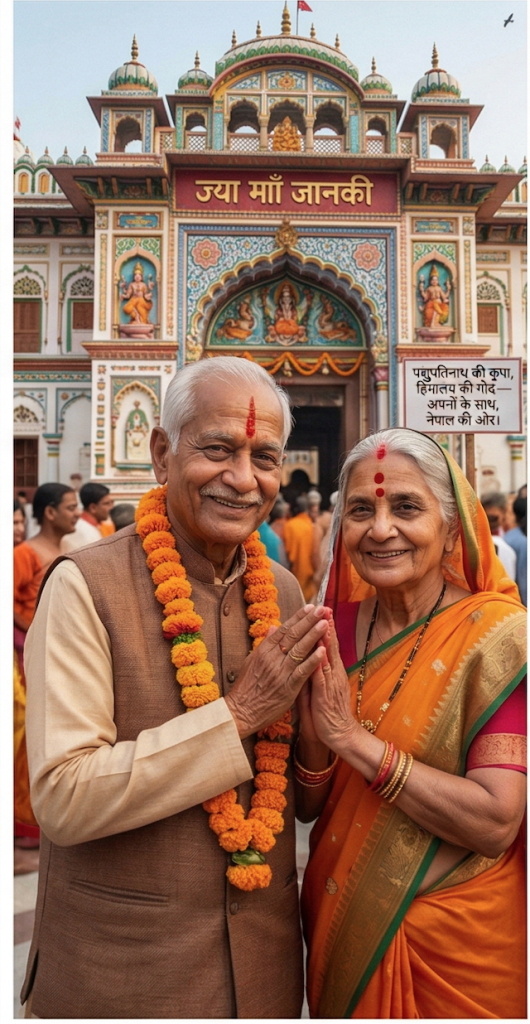
- Indians: Nepal is a natural travel extension for Indian visitors. Nepal hosts many sacred Hindu and Buddhist sites (e.g. Pashupatinath, Janakpur, Lumbini) that complement Indian cultural tours. Millions of Indians visit annually, and language similarities (Hindi/Nepali) ease communication. No visa is required, so Indians face no paperwork. Moreover, Nepal’s emerging middle-class tourism fits Indian budgets: a Himalayan trek can be cheaper than an international beach holiday. Indians are also sensitive to safety, Nepal’s low crime rate and familial atmosphere (many Nepali guides speak Hindi) make it comfortable for families, solo women and first-time travelers. For budget-conscious travellers, GNTE offers both luxury lodge treks and very affordable camping treks, tailoring to all price points.
- Chinese: China’s growing outbound tourism seeks new destinations. Nepal’s Himalaya hold strong appeal for Chinese tourists (especially those interested in Tibetan culture or Buddhist pilgrimage). The ease of a free 30-day visa-on-arrival and the fact that Chinese is often spoken in Nepali tourism circles (signage, menus, tours) makes Nepal accessible. Great Nepal Treks provides Chinese-speaking guides on demand. Cultural ties (Nepal gave a gift of the Bodhi tree to China) and high-profile events (like the 2020 China-Nepal Friendship Year) have boosted awareness. Chinese groups often enjoy Pokhara’s lakes, Chitwan’s safaris, and heritage sites. Lastly, many Chinese travelers appreciate Nepal’s novelty and unspoiled landscapes, plus high safety rankings.

For all travelers, price-sensitivity is addressed by Nepal’s competitive rates: lodging ranges from $10/night hostels to mid-range guesthouses at $30–50, far cheaper than Europe or the US. Meals and guide services are similarly affordable. This value is compelling when comparing, say, an Everest trek versus other global treks. GNTE frequently runs group departures (with discounts) and special offers during shoulder seasons to make travel even more budget-friendly.
Why Choose Great Nepal Treks & Expeditions?
Great Nepal Treks & Expeditions (GNTE) is a leading Nepal tour operator, founded by Nepalis with decades of expertise. Here’s why GNTE is the ideal partner:
- Credentials & Affiliations: GNTE is fully licensed and affiliated with Nepal’s top tourism bodies. The agency is a member of the Nepal Tourism Board (NTB), the Trekking Agencies’ Association of Nepal (TAAN) and the Nepal Mountaineering Association (NMA), evidence of its recognized standards. GNTE’s chairman, Surya Bahadur Ghimire (Dr. Surya), served as a TAAN Executive Member, ensuring insider knowledge of best practices. This close government and industry alignment means GNTE stays updated on policies (like Park permits or aviation notices) to keep clients safe and legal.
- Safety Protocols: All GNTE treks use experienced IAATO-certified guides and strong porter teams. Staff are trained in wilderness first aid, altitude illness prevention, and emergency evacuation procedures. GNTE maintains satellite comms and liaises with the Himalayan Rescue Association (HRA) for medical support on high treks. Accommodations (lodges or camping) meet international hygiene standards, especially in COVID-19 protocols. GNTE also offers optional insurance arrangements or partnerships (transit insurance, rescue insurance) given current uncertainties. In short, GNTE ensures you’re never alone in the mountains.
- Sample Itineraries: GNTE’s portfolio covers all interests. Classic examples include:
- Everest Base Camp Trek (14 days): Flights KTM–Lukla, Everest View Lodge stay, Kala Patthar sunrise – US$1,500 all-inclusive.
- Annapurna Circuit Trek (13 days): Jagat–Muktinath loop, Thorang La Pass, Poon Hill viewpoint – US$1,300.
- Cultural Heritage Tour (5 days): Kathmandu Durbar Square, Patan, Nagarkot sunrise – US$400.
- Royal Chitwan Safari (3 days): Jungle walks, elephant rides, Tharu village homestay – US$250. (See GNTE website for full details.) Each itinerary is tailored to group size and season. For example, spring departures include rhododendron-view trails; autumn trips sync with local festivals.
- Value Proposition & Reviews: GNTE has received overwhelmingly positive reviews. On Facebook, 9067+ likes and 90% recommendations (140 reviews) attest to satisfied clients. TripAdvisor reviews praise GNTE’s professionalism: recent guests (March 2025) say their Langtang/Gosainkunda trek was “unforgettable” thanks to guide Great Nepal Treks and clear organization. GNTE also supports sustainability and community (72% of profits donated via their “Tourism for a Cause” initiative). Importantly, GNTE offers competitive pricing: their all-inclusive packages (lodging+guide+permits+food) often undercut comparable Western operators because of local efficiency. They provide full service: from airport pickup (meet your guide at KTM airport!) to drop-off, with 24/7 helpline available (email and WhatsApp).
- Contact and Booking: Getting started is easy. Visit greatnepaltreks.com or email [email protected], and GNTE’s international agents will respond within 24 hours (often in Hindi, Chinese or English). Payment can be made securely online or on arrival (in local currency). GNTE also offers a free quote system: just provide travel dates, group size and preferences, and they will customize an itinerary.
In summary, Great Nepal Treks & Expeditions combines certified expertise with passionate local knowledge to deliver safe, memorable journeys. Especially now, with travel routes changing rapidly, GNTE’s guidance is invaluable to ensure smooth logistics and on-the-ground support.
Tables and Figures
Flight Route Comparison: The table below illustrates typical flight options for travelers from key markets to Kathmandu, highlighting how to bypass conflict zones.
| Origin | Airline & Route (pre-crisis) | Alternate Routing (avoiding Middle East) |
| Sydney, Australia | Emirates via DXB (SYD–DXB–KTM) | Singapore Airlines via SIN (SYD–SIN–KTM) |
| Perth, Australia | Qantas via DXB (PER–DXB–KTM) | Turkish via IST (PER–IST–KTM; via Caucasus) |
| Melbourne, AUS | Etihad via AUH (MEL–AUH–KTM) | Malindo/Scoot via KUL–KTM (MEL–KUL–KTM) |
| New Delhi, India | Air India direct (DEL–KTM) | (Same: still daily direct flights) |
| Bengaluru, India | Air India direct (BLR–KTM) | (Same: 3x weekly flights) |
| Beijing, China | Air China direct (PEK–KTM) | (Same: 3x weekly flights) |
| Shanghai, China | via Guangzhou with Nepal Airlines (SHA–CAN–KTM) | (Same route; or connect via ICN to KTM) |
| Singapore | Singapore Airlines (SIN–KTM) | (No change needed) |
| Bangkok | Thai Airways (BKK–KTM) | (No change) |
Seasonal Attractions Calendar: Nepal’s climate and festivals vary by season. This table lists highlights for visitors:
| Season | Weather & Scenery | Major Festivals / Activities |
| Spring (Mar–May) | Clear skies, warm days; rhododendrons in bloom; ideal trek season | Holi (Mar), Nepali New Year; best trekking conditions; migratory birds in Chitwan |
| Monsoon (Jun–Aug) | Hot, heavy rains in lowlands; landslides possible | Local Teej festival; lush jungles; fewer tourists (off-peak rates) |
| Autumn (Sep–Nov) | Cool, dry; clear mountain views; peak season | Dashain (Oct), Tihar (Nov); Mani Rimdu festival in Everest region |
| Winter (Dec–Feb) | Cold nights, snow above 3,000 m; solstice | Elephant polo in Chitwan; off-season discounts; Tihar celebrations continue |
Investment & Safety Indicators: Nepal scores well on regional safety and tourism metrics:
| Indicator | Nepal Value | Regional / Source Comparison |
| Global Peace Index 2025 (score/rank) | 1.987 (76/163) | 2nd in South Asia after Bhutan (India=115, Pak=144) |
| Foreign Tourist Arrivals 2025 | 1,158,459 (↑1%) | 96.8% of 2019 levels; India top source (25%) |
| Tourism’s share of GDP | 7–8% | High for developing country |
| FDI in Tourism (2025 commitments) | 103 projects | Top sector for FDI (hotels, resorts) |
| Ease of Doing Business (Rank) | 100 (WBG 2020) | Moderately challenging but improving |
| Homicide rate (per 100,000) | 3 (World Bank) | Low – comparable to Europe |
(Sources: World Bank/Nepal Rastra Bank/NTB/Peace Index reports.)
Conclusion
Nepal is open for business – and adventure. The Middle East crisis has muddied some flight paths, but Nepal’s tourism landscape remains strong. With nearly full recovery in visitor numbers, government support, and a reputation for safety, now is an opportune moment for Australians, Indians, Chinese and others to explore the Himalayas. Nepal offers unparalleled natural beauty, cultural heritage, and friendly hospitality, at very attractive prices and with simple entry procedures.
Great Nepal Treks & Expeditions stands ready to be your guide. As a locally-owned, certified operator affiliated with all national tourism authorities, GNTE combines deep local knowledge with international standards. Their tailored itineraries, experienced guides, and safety-first ethos ensure you can travel with confidence. In these uncertain times, let a trusted Nepali partner handle the details so you can focus on the experience.
Book your Nepal adventure today – before word spreads of this Himalayan treasure. With routes opening up via alternative flight paths and the spring season in full swing, the mountains are calling. Contact Great Nepal Treks at [email protected] or +977-9851078338 to lock in your journey. Namaste! see you on the trail!